
Website vs Landing Page: Which One Generates More Leads?
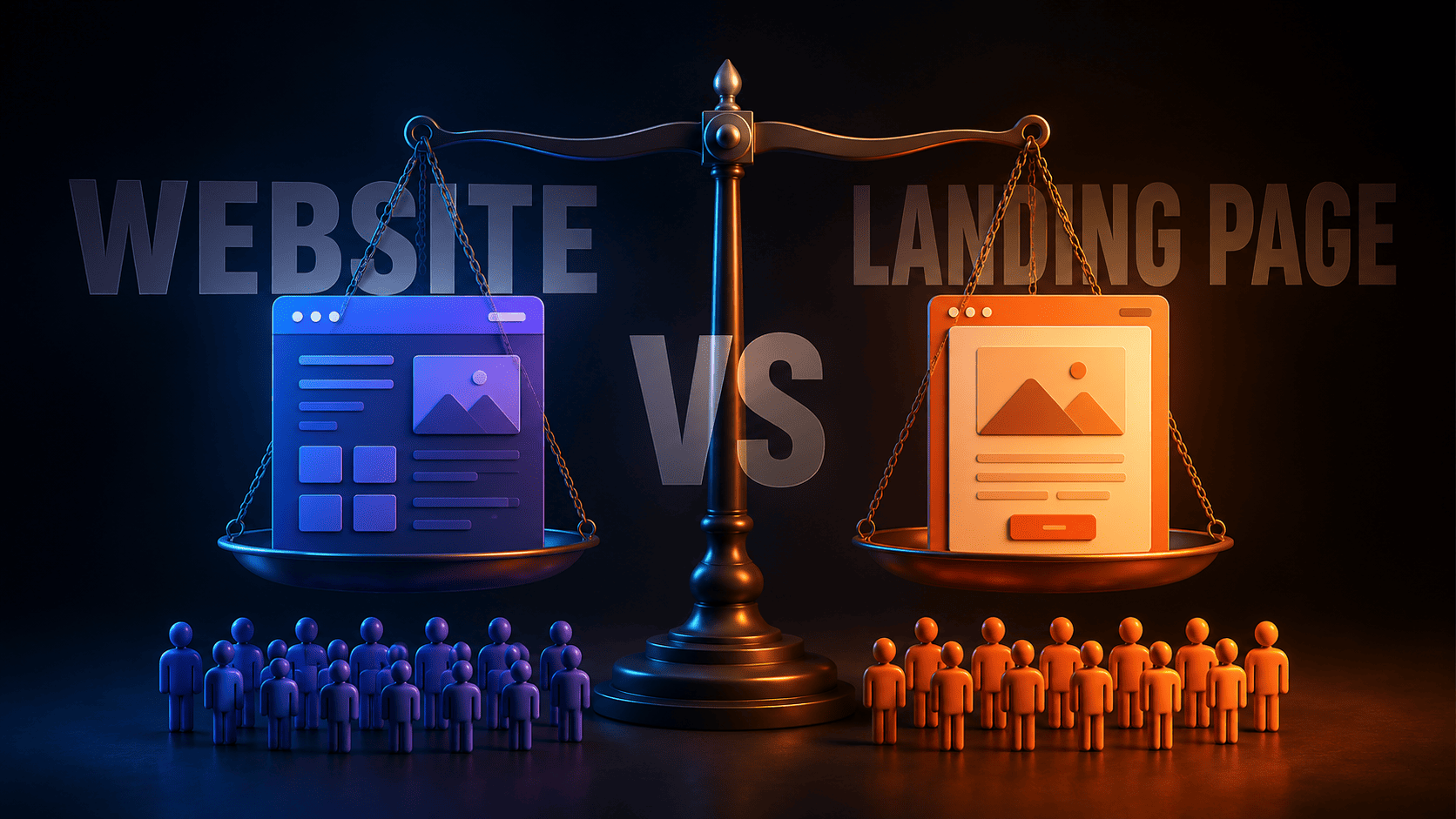
Website vs Landing Page: Which One Generates More Leads?
Website vs Landing Page: Which One Generates More Leads? is a question many business owners ask before investing in digital marketing. Although both are powerful online assets, they serve completely different purposes. Unfortunately, choosing the wrong option often results in fewer leads, wasted advertising budgets, and lower conversion rates.
A website is designed to showcase your business, services, portfolio, and expertise over the long term. On the other hand, a landing page is created with one specific goal, such as collecting leads, booking demos, or generating sales. Therefore, understanding the difference is essential for making the right marketing decision.
Many businesses believe that sending every visitor to their homepage will generate leads automatically. However, traffic alone does not create conversions. Instead, visitors need a focused experience that guides them toward a single action.
According to Google's documentation on creating helpful content, websites should focus on providing value and helping users accomplish their goals. Similarly, landing pages should remove distractions and simplify the decision-making process.
In this guide, you'll learn when a website performs better, when a landing page generates more leads, and why combining both often produces the best marketing results.
What Is a Website?
A website is a collection of multiple pages that represent your business online. It typically includes pages such as Home, About Us, Services, Portfolio, Blog, and Contact. Visitors can freely explore these sections to learn more about your company, products, and expertise.
Moreover, websites are ideal for long-term brand building, SEO, and organic traffic growth. Since users have access to detailed information, websites help establish trust before a buying decision is made.
What Is a Landing Page?
A landing page is a single-page marketing asset created with one specific objective. Unlike a traditional website, it focuses entirely on encouraging visitors to complete one action, such as filling out a lead form, booking a demo, downloading an eBook, or requesting a consultation.
Furthermore, landing pages eliminate unnecessary navigation and distractions. As a result, visitors remain focused on the primary call-to-action, which usually leads to higher conversion rates.
Website vs Landing Page: Key Differences
Website builds your brand and shares complete business information; landing page is designed to achieve one specific conversion goal.
Website contains multiple interconnected pages; landing page consists of a single focused page.
Website includes full navigation menus and links; landing page minimizes or removes navigation to reduce distractions.
Website offers multiple CTAs for different actions; landing page focuses on one clear and compelling CTA.
Website targets multiple keywords across different pages; landing page focuses on one highly targeted keyword or audience.
Websites are built for information and engagement; landing pages generally deliver higher conversion rates.
Websites support overall marketing efforts; landing pages are optimized for Google Ads and social media campaigns.
Website encourages visitors to explore various pages; landing page guides users toward taking one immediate action.
Websites are ideal for branding, SEO, and business presence; landing pages are best for lead generation, product launches, and marketing campaigns.
Lead Generation: The Biggest Difference
The biggest difference between a website and a landing page is their primary objective. A website is designed to provide information, educate visitors, and build long-term credibility. Therefore, users often browse multiple pages before making a decision.
In contrast, a landing page is designed to drive one specific action immediately. Whether the goal is lead generation, demo booking, or product sales, every section supports that single objective. Consequently, landing pages usually convert visitors more effectively than standard website pages.
Why Landing Pages Usually Generate More Leads
Landing pages remove unnecessary distractions. Instead of giving visitors multiple navigation options, they present one clear message and one call-to-action. For example, a Facebook advertisement promoting a free website audit should direct users to a landing page with a simple "Book Your Free Audit" form rather than a general homepage.
Additionally, focused content creates stronger message consistency. If someone clicks an ad for "Free CRM Demo," they expect to see information about that exact offer. Therefore, matching ad messaging with landing page content increases trust and conversions.
Landing pages also help visitors make decisions faster. Rather than exploring several pages, users immediately understand the value of the offer and can take action with minimal effort.
When a Website Generates Better Leads
A website performs better when users are researching a business before making an important purchase. For example, companies offering software development, enterprise solutions, or consulting services often require visitors to review case studies, client testimonials, blogs, and portfolios before contacting the business.
Similarly, websites perform exceptionally well for SEO because they contain multiple optimized pages targeting different keywords. As a result, businesses can attract long-term organic traffic while continuously building trust and authority.
Furthermore, businesses offering multiple services benefit from websites because visitors can compare solutions before making a decision. This approach works particularly well for agencies, SaaS companies, healthcare providers, and educational institutions.
When You Should Use a Landing Page
Landing pages are ideal for paid marketing campaigns where every click has a cost. Instead of sending users to a homepage, businesses should direct visitors to a highly relevant page focused on one offer.
Common examples include Google Ads campaigns, Facebook Ads, webinar registrations, free eBook downloads, product demos, free consultations, and limited-time promotional offers. Because every element supports one conversion goal, landing pages usually deliver higher ROI.
Biggest Mistakes Businesses Make
One of the biggest mistakes is sending paid advertising traffic directly to the homepage instead of a dedicated landing page. Homepage visitors often become distracted because they see multiple navigation links and competing calls-to-action.
Other common mistakes include weak headlines, too many CTAs, slow loading speed, missing testimonials, long navigation menus, and asking for excessive information in lead forms. Consequently, visitors leave before completing the desired action.
Website + Landing Page = The Best Strategy
Many businesses think they must choose between a website and a landing page. However, the smartest companies use both because they solve different marketing challenges.
A website builds trust through blogs, portfolios, testimonials, service pages, and company information. Meanwhile, landing pages convert campaign visitors into leads through focused messaging and simplified user journeys.
Therefore, combining a professional website with dedicated landing pages creates the strongest lead generation strategy.
Understanding the Conversion Funnel
Paid Advertising Funnel
Facebook Ad
↓
Landing Page
↓
Lead Form
↓
Thank You Page
↓
Sales Call
↓
Customer
Organic SEO Funnel
Google Search
↓
Website Blog or Service Page
↓
Case Studies & Testimonials
↓
Contact Page
↓
Lead
↓
Customer
Although both funnels generate leads, they support different marketing goals. Therefore, businesses should optimize both pathways.
Common Myth vs Reality
Myth: Websites don't generate leads.
Reality: Well-optimized websites with strong SEO, trust signals, and compelling CTAs generate consistent long-term leads.
Myth: Landing pages cannot rank on Google.
Reality: SEO-optimized landing pages can rank for targeted keywords when they provide valuable and relevant content.
Myth: More information always increases conversions.
Reality: Only relevant information improves conversions. Too much content often creates confusion and decision fatigue.
Website & Landing Page Checklist
Landing Page Checklist
- One clear headline
- Strong value proposition
- Single primary CTA
- Minimal navigation
- Trust badges
- Customer testimonials
- Fast loading speed
- Mobile optimization
- Short lead form
- Clear benefits
- Social proof
- Thank You page
- Analytics tracking
- Heatmap tools
- A/B testing enabled
Website Checklist
- Professional homepage
- Service pages
- About Us page
- Contact information
- Portfolio
- Client testimonials
- Case studies
- Blog section
- SSL certificate
- Fast loading
- Mobile-friendly design
- Internal linking
- SEO optimization
- Clear CTAs
Website vs Landing Page Examples
A digital marketing agency may use its website to showcase services, client success stories, and blog content. However, when running Google Ads for a "Free SEO Audit," it sends visitors to a dedicated landing page with a simple lead form.
Similarly, a SaaS company may use its website to explain product features while using landing pages for webinar registrations, free trials, and product demonstrations.
Final Verdict
A website is the best choice if your goal is to build a strong brand, attract long-term SEO traffic, and showcase multiple services. It helps visitors learn about your business and builds trust over time.
On the other hand, a landing page is the better option when your primary objective is lead generation, sales, demo bookings, or campaign-specific conversions. Because it removes distractions and focuses on one goal, it typically delivers higher conversion rates.
However, the most effective strategy is not choosing one over the other. Instead, successful businesses use a professional website to establish credibility while using dedicated landing pages for paid advertising and lead generation campaigns.
Ultimately, your website builds trust, your landing pages generate conversions, and together they create a powerful digital marketing system that delivers sustainable business growth.
FAQ Section
A website contains multiple pages for branding and information, while a landing page focuses on one specific conversion goal.
Landing pages usually generate more leads for campaigns because they have a single CTA and fewer distractions.
Yes. In fact, combining both delivers the best results by building trust through your website and generating conversions through landing pages.
Yes. Dedicated landing pages typically produce higher conversion rates because they match user intent more closely.
Yes. Well-optimized landing pages can rank for targeted keywords and generate organic traffic.
Choose a website when your goal is branding, SEO, showcasing multiple services, or supporting a long buying cycle.
Focused messaging, one CTA, fewer distractions, fast loading speed, and a clear value proposition improve conversions.
Absolutely. Many successful businesses create dedicated landing pages for different campaigns, services, products, and advertising channels.
Other Post
Website vs Landing Page: Which One Generates More Leads? Website…

Why Your Website Isn’t Generating Leads (And How to Fix…